






Hyundai H100 Downpipe
We source downpipe for every H100 generation sold in South Africa, then check the fit against your VIN before it leaves the warehouse
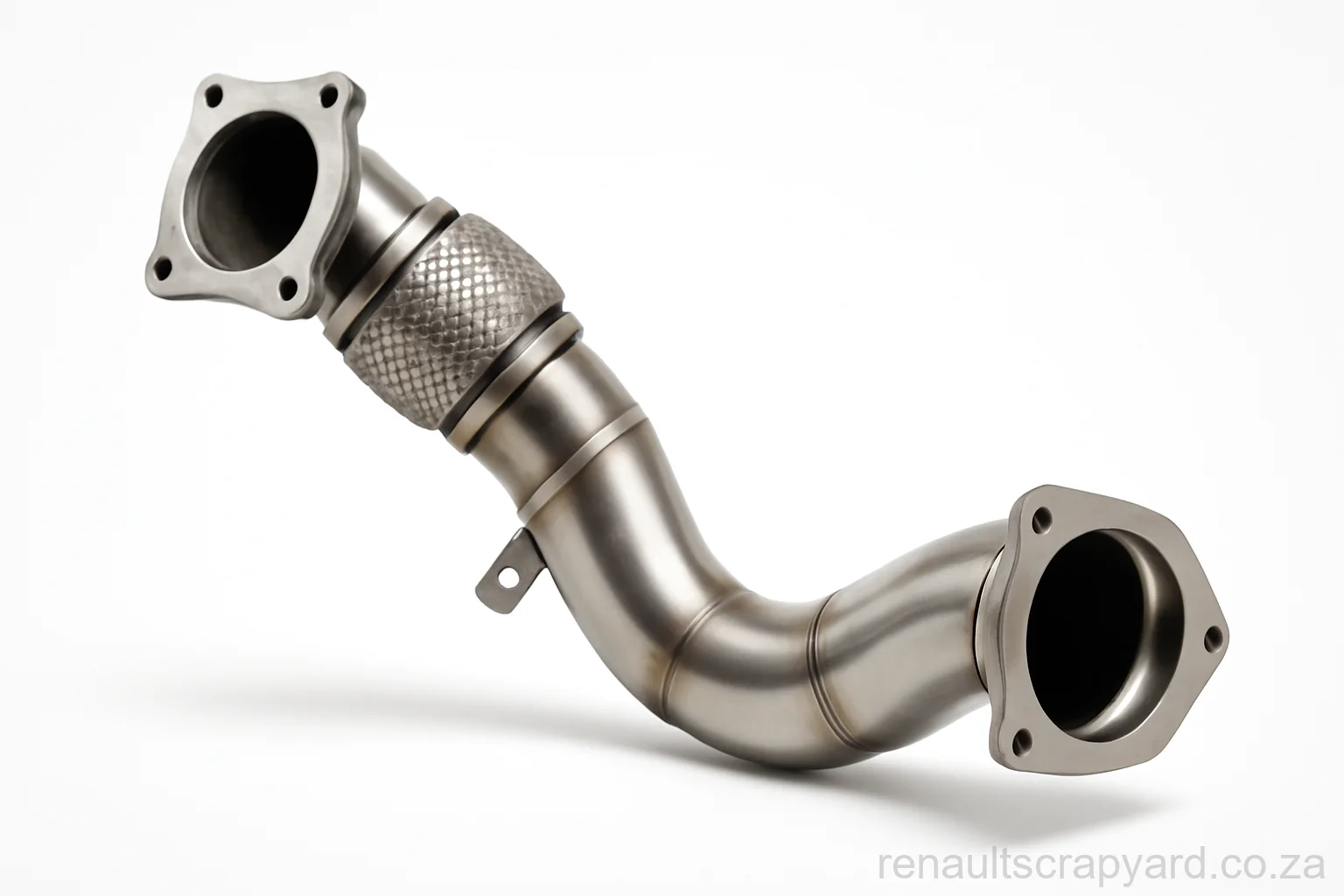
What Are Hyundai H100 Downpipe?
The downpipe is the first section of exhaust bolted to the turbo on Hyundais like the i20 N, i30 N T-GDi and Veloster-R. It carries searing exhaust gas into the cat and onward to the silencers. On SA performance i30 N and Veloster cars it's the first thing owners swap when chasing power.
Signs You Need New Downpipe
What a parts desk needs to know about your H100
What changes across the range
Sold here across Porter, Porter II and the H100 bakkie, the H100 is not one car for parts purposes — it is several.
Dropside, tipper and canopy conversions mean the load body is frequently not standard, so load-bed and rear-body parts have to be matched to the conversion rather than to the model.
Worth knowing: the H100no Kia equivalent — a dedicated light-commercial cab-over platform.
What we check on downpipe
- •The generation code, because H100 parts lists split on it
- •The engine family — this H100 was sold with the 2.5 and 2.6 diesels as badged on the SA derivatives
- •The model year and engine code, and which section has failed
- •Whether the car is pre- or post-facelift within its generation
In South Africa the H100 is mostly small-business transport that is loaded to its limit daily, which is why clutch, driveline and front-suspension parts dominate demand rather than trim or electronics. That is the wear pattern we stock and source against.
H100 Downpipe: Common Questions
Will downpipe from another H100 fit mine?
Not automatically. The H100 sold in South Africa as Porter, Porter II and the H100 bakkie, and dropside, tipper and canopy conversions mean the load body is frequently not standard, so load-bed and rear-body parts have to be matched to the conversion rather than to the model. Send us the generation code off your VIN plate and we will confirm it either way before anything is dispatched.
Can you source downpipe for the H100 if local stock is dry?
Usually, yes. The H100 no Kia equivalent — a dedicated light-commercial cab-over platform, which gives us a second catalogue to search when Hyundai-listed stock runs out. We will tell you what we are quoting rather than leaving you to guess.
How much does a Hyundai downpipe cost in South Africa?
Real SA retail: universal 76mm downpipes run from R2,999 to R3,500, with units around R4,950 and vehicle-specific full systems ranging R6,000 to R13,000 through our supplier network. Send your VIN and intended use (repair vs upgrade) for a quote.
What are the symptoms of a cracked downpipe?
A loud blow or ticking noise at idle that gets louder on throttle, a whistle as boost climbs, black soot staining near the flange and P0420 cat-efficiency fault codes. On i30 N T-GDi and Veloster-R the cracks typically start at the turbo flange weld.
Can I drive my Hyundai with a leaking downpipe?
Only briefly. A downpipe leak vents hot exhaust into the engine bay (fire risk) and fools the lambda sensor into misreading fuel trims. The ECU may go into limp mode. Fix it before it damages the cat or triggers an emissions failure on roadworthy.
Does a downpipe add power to a Hyundai?
On turbo models — yes, noticeably. A free-flow downpipe on an i30 N T-GDi, Veloster-R or i20 N reduces exhaust back-pressure and typically adds 10-15 kW paired with a remap. Non-turbo Hyundais see almost no gain from a downpipe swap alone.
Which Hyundai models use a turbo downpipe?
All turbocharged Hyundais do — i20 N, i20 T-GDi, Tucson 1.2 Kappa turbo, i30 N T-GDi, Creta T-GDi, Sonata GT and Veloster-R. Non-turbo Getz and early i20 1.4/1.6 naturally aspirated cars have a conventional front pipe instead.
Tell us which H100 you have
The H100 sold here as Porter, Porter II and the H100 bakkie, and they do not share one parts list. Give us the generation code and we will do the rest.